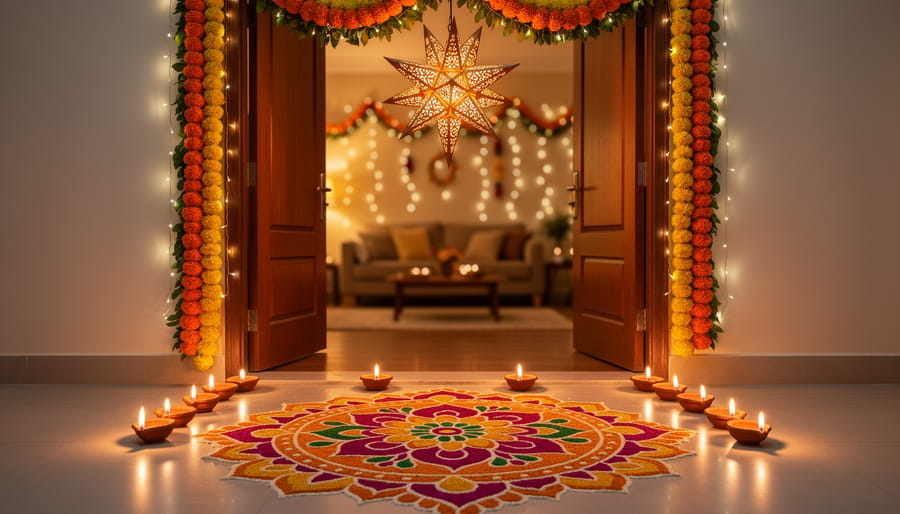
A Diwali-ready home comes down to five simple pieces: a rangoli at the entrance, a marigold toran on the door, clusters of clay diyas, an akash kandil (star lantern) overhead, and warm festive lights tying it all together. Set aside an afternoon, and you can have the whole look in place without any special skills or a big budget.
Timing matters more than most people expect. Diwali 2026 fell on Sunday, 8 November, and the guidance was to finish decorating by 5:57 PM, when Pradosh Kaal begins in Nashik, so the Lakshmi Puja muhurat of 6:22 to 8:22 PM could unfold in a home that already glowed. If you’re planning ahead for the next festival, work backward from that same idea: decorate first, then settle in for Diwali Puja, also known as Deepavali Puja.
Think of it as building a welcome from the outside in. Rangoli greets guests at your doorstep, marigolds frame the entrance, diyas flicker at every threshold, and the lantern signals celebration from above. Add a few seasonal scents drifting through the rooms, and the whole house feels like a festival. Here’s the clear sequence, along with a materials list, safety tips, and a checklist to confirm everything’s ready.
Diwali 2026 Key Details to Plan Around
Planning your decorating around the date makes the whole day feel calmer. Diwali 2026 falls on Sunday, 8 November, so that is the day to have everything glowing and in place. If you’d like the bigger picture of how the festival days build up, our Diwali timeline walks through the days leading in.
For the evening itself, aim to finish decorating by 5:57 PM on Sunday, 8 November, when Pradosh Kaal begins in Nashik. The Lakshmi Puja muhurat then runs from 6:22 to 8:22 PM. You may also hear this ceremony called Deepavali Puja, so if you see either name on a calendar, it’s the same puja.
One friendly note: these timings are given for Nashik, and they shift from place to place. Check a local source such as this Diwali puja calendar for your own city before you set your schedule.
The Five Decorations That Make a Home Feel Like Diwali
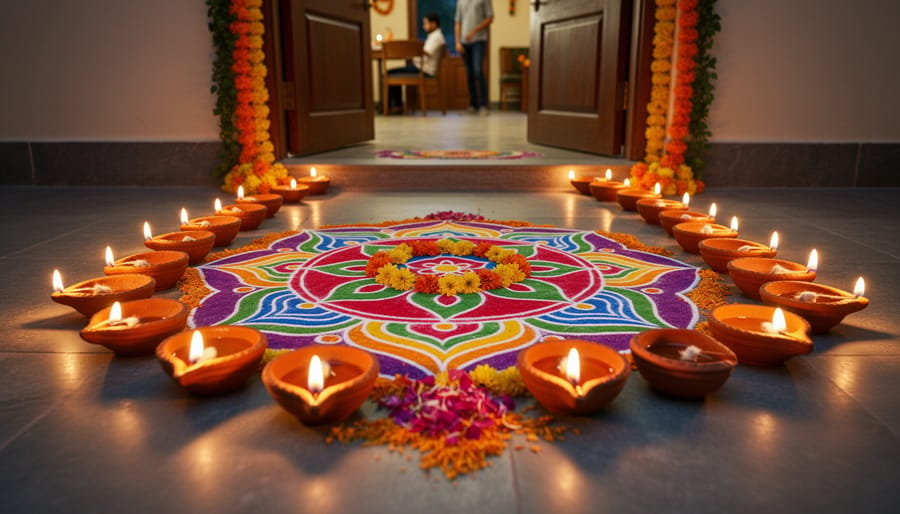
Five simple touches do most of the work when you want your home to feel like Diwali. Each one adds something different, and together they pull a glow from the doorstep right into your living space.
- A rangoli at the entrance: bright colors and patterns that greet guests before they even knock.
- A marigold toran on the door: fresh orange and gold blooms with a lightly earthy scent.
- Clay diyas in clusters: tiny flames that flicker softly and warm every corner they touch.
- An akash kandil (star lantern): a glowing star hanging overhead like a little piece of the night sky.
- Warm string lights: a gentle, golden shimmer that ties everything together.
Think of them as layers of welcome. The rangoli says “come in,” the toran frames the doorway, the diyas bring that classic flicker, and the lantern and string lights keep the glow going well into the evening. Because they work from the outside in, guests feel the festive mood from the first step.
You don’t need to do all five to make your home feel special. Even one or two, done with care, can change the whole feeling of a space. Start with whatever feels easiest, and add more as time and energy allow.
Tools and Materials to Gather Before You Start
Before you start, gather everything in one spot so you’re not hunting for a hook while your marigolds wilt. If you want the full picture of how these pieces come together, our Diwali decorating guide goes deeper, but here’s the shopping list for the five classic elements.
- Rangoli: colored powder, flower petals, or chalk if you’d like something gentler on hard-to-clean surfaces. Renter swap: a reusable stencil keeps lines crisp and cleanup easy.
- Marigold toran: fresh marigold garlands plus sturdy thread or thin wire to string them. Renter swap: a removable hook at the top of the doorframe.
- Clay diyas: a good handful of clay diyas, oil or ghee, and cotton wicks. Safer swap: battery-operated diyas for spots near flowers or fabric.
- Akash kandil: one star lantern with a hook or hanger strong enough to hold it. Renter swap: an adhesive hook rated for its weight.
- Warm-white string lights: enough length for your railing, window, or doorframe, with outdoor-rated strings for outside spots.
A few extras make the whole thing smoother: a small tray to corral your diyas, scissors, a spray bottle for misting flowers, and matches or a lighter kept well out of little hands. Buy flowers as close to the day as you can so they stay fresh, and check that your lights work before you hang them. With Diwali on Sunday, 8 November 2026, a short gathering session now saves you scrambling later.
Safety Tips for Diyas, Lights and Busy Doorways
A few simple habits keep the glow cheerful and worry-free. Start with placement: set open flames well away from curtains, marigold garlands, dry flowers and anything hanging, since those catch quickly. Put each diya on a stable, heat-safe surface like a metal tray, a stone step or a ceramic plate, and keep them clear of the doormat and tight corners where someone might brush past.
Kids and pets are drawn to anything that flickers, so keep lit diyas out of their reach, up on a windowsill or a high tray. Battery-operated diyas are your best friend near the toran and the akash kandil, where flowers and paper sit close to the light.
For string lights, run a quick check before you hang them. Look for frayed wires or cracked bulbs, and don’t plug too many strands into one outlet. Outside, use lights rated for outdoor use.
Finally, keep a clear path at the entrance so guests can walk in without stepping around flames or cords. And trust your senses. If a wick sputters, a flower starts drying out near a flame, or a light feels hot to the touch, move it or switch it off right away.
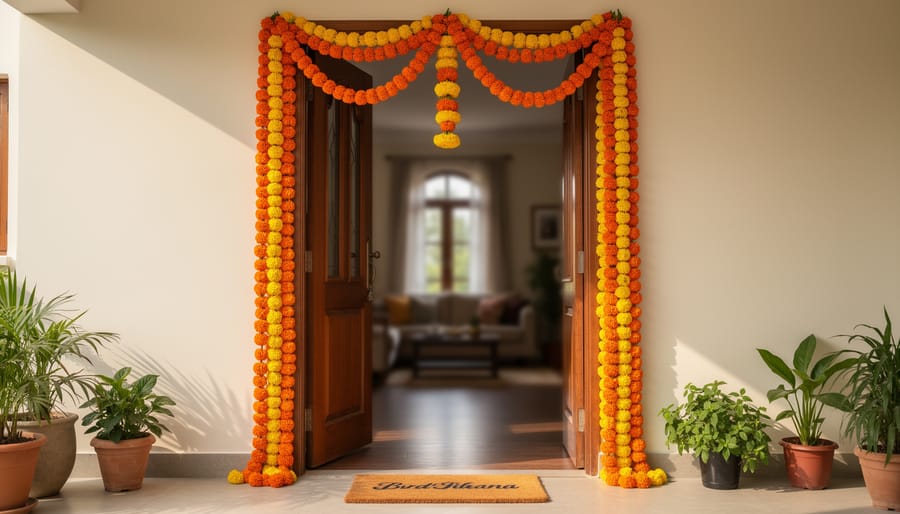
Step-by-Step: Decorating Your Home for Diwali From the Doorstep In
Step 1: Create a Welcoming Rangoli at the Entrance
Start with the simplest design you can picture, because a rangoli doesn’t need to be fancy to feel welcoming. A clean circle, a ring of triangles, a lotus with eight petals, or a stencil all look lovely at the doorstep.
Sketch your outline lightly first with chalk so you can fix mistakes easily. Then fill in the shapes with colored powder, working from the center outward so your hand never smudges finished sections. Prefer something softer? Fresh flower petals or rice flour give you a gentle, natural look and sweep away easily afterward, which is handy on hard-to-clean floors.
No wide entry? Make a smaller version on a tray or a large plate and set it just inside the door. It still greets guests with a burst of color.
Step 2: Hang a Marigold Toran on the Door
A marigold toran is simpler than it looks. Thread fresh marigold heads onto a strong cotton string or thin wire using a long needle, passing it through the base of each bloom. Alternate orange and yellow if you like, and leave a little room at both ends for tying.
Hang it across the top of the doorframe with a removable adhesive hook at each corner, so there’s no drilling and no marks left behind. Let it dip gently in the middle for that classic swag shape.
To keep the flowers fresh until evening, mist them lightly and keep the garland out of direct sun until you’re ready to hang it. A fabric or faux toran is a lovely alternative, and it can be reused year after year.
Step 3: Arrange Clay Diyas in Clusters
Diyas glow best in groups, so think in clusters rather than single flames. Gather three to five diyas and vary the heights by setting some on small upturned bowls or little stands. Group them on a tray, along the steps, or across a windowsill.
If your diyas are traditional clay, soak them in water for a few hours first so they don’t drink up all the oil. Pat them dry, tuck in a cotton wick, and fill with oil or ghee.
Place clusters just beside the rangoli, never on top of the design, and keep them on stable, heat-safe surfaces. For spots near the toran, curtains, or anywhere kids and pets wander, swap in battery-operated diyas. They give the same soft flicker without the worry.
Step 4: Hang an Akash Kandil (Star Lantern)
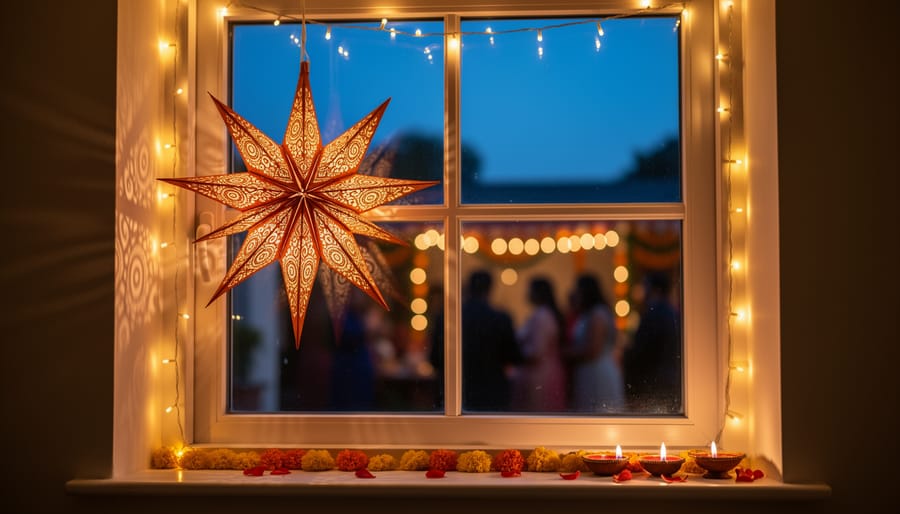
An akash kandil is a star-shaped lantern traditionally hung during Diwali, and it’s one of the five classic decorations for the festival. The porch, a balcony, or a bright window all make good spots, since the glow shows best where it can be seen from outside.
Start by choosing a sturdy hook or a removable adhesive hanger rated for the lantern’s weight. Give it a gentle tug before you let go. If you’re renting, a tension rod across a window frame works nicely too.
Hang it a little off to one side of the door so it doesn’t crowd the marigold toran. At dusk, the lantern’s light spills softly over the diya clusters below.
Step 5: Finish With Warm String Lights
Warm-white string lights are the finishing touch that pulls everything together. Choose a soft, golden tone rather than a cool bluish white, since it echoes the flicker of the diyas and flatters the marigolds. Drape them along a railing, around a window, or across the top of the doorframe just above the toran, letting the strands dip gently for a relaxed look.
Tuck cords along walls, under mats, or behind planters so nobody trips on the way in. Outside, use lights rated for outdoor use, and keep plugs and connections off damp ground. Switch them on and step back. That’s the glow that makes the whole entrance feel welcoming.
A Simple Seasonal Craft: Make Your Own Diya Tray or Paper Lantern
Plain clay diyas are the perfect blank canvas, and painting them is a project the whole family can share. Kids tend to love this one, and handmade pieces add a warmth that store-bought decor just can’t match.
Here’s what you’ll need: unglazed clay diyas, acrylic paints in jewel tones and gold, small brushes, a shallow tray or wooden board, and a clear sealer if you’d like the colors to last. Cover your table first, because little hands get enthusiastic.
1. Wipe each diya clean and let it dry completely.
2. Paint a base coat inside and out, then let it set.
3. Add dots, petals or tiny stars with a fine brush or even a cotton swab.
4. Seal and dry, then arrange the diyas on your tray in a cluster of varied heights.
If you enjoy the glow-making side of the season, you might also like this easy candle DIY for more flickering ideas. Keep any flames on a heat-safe surface, or use battery diyas for the painted tray.
A Peek Inside a Diwali-Ready Home
Picture this: you step up to the front door and a rangoli glows underfoot, petals and colored powder in a simple lotus pattern. Above you, a marigold toran sways, and its earthy, citrusy scent drifts out to meet you.
Inside, the living room hums with a soft flicker. Clay diyas sit in clusters on a tray, along the windowsill and beside a bookshelf, each at a slightly different height. In the window, an akash kandil glows like a small star, casting warm light across the curtains.
Down the hall, the dining table waits, set with a platter of sweets and a few diyas kept safely to one side. It smells like cardamom and ghee, and everything feels ready for guests.
Living somewhere small? Scale it down. A mini rangoli on a tray, a short toran, three or four diyas on a plate, and one lantern in the window will carry the same cozy feeling.
Bringing the Kitchen Into the Celebration: Diwali and Seasonal Baking Traditions
Diwali is a season of sweets as much as lights, and your kitchen deserves a spot in the celebration right alongside the doorway. Families share treats with neighbors, friends and relatives, so think of the baking and the decorating as one warm, connected experience.
Here are a few easy ways to link the two:
– Set a sweets platter near your diya cluster, so the flicker of the flames lights up the treats and guests naturally gather there.
– Wrap homemade treats in small boxes or cloth bundles for gifting, and tuck in a marigold petal or a bit of ribbon that echoes your toran.
– Let the aroma of baking drift toward the entrance. A warm, sweet scent greets visitors almost as nicely as the rangoli does.
When you’re ready to bake, browse our seasonal recipes for treats that suit the occasion.
Check Your Work and Plan the Next Steps
Before the evening begins, do one slow walk from the doorstep inward. Think of it as a quick check at the door:
- Rangoli is intact, visible and free of footprints.
- Toran is secure and still looking fresh.
- Diyas sit steady and well away from curtains, garlands and dry flowers.
- Akash kandil and string lights are switched on and working.
- The pathway is clear for guests.
Lakshmi Puja timing varies by city, so check your local calendar before the evening starts. After the puja, re-trim wicks, refresh any wilting flowers, and tuck reusable pieces away for next year.
Diwali Home Decorating FAQs
When should I finish decorating for Diwali 2026?
Diwali falls on Sunday, 8 November, and Pradosh Kaal begins at 5:57 PM in Nashik, so aim to be done by then. The Lakshmi Puja muhurat runs 6:22 to 8:22 PM. Timings vary by city, so check a local calendar for yours.
What are the main Diwali decorations?
The classic five are a rangoli at the entrance, a marigold toran on the door, clay diyas in clusters, an akash kandil (star lantern), and warm string lights. You don’t need all five to make your home feel festive.
Can I decorate if I rent?
Absolutely. Removable hooks hold a toran or lantern without marking the walls, a stencil or chalk keeps rangoli easy to clean up, and battery diyas give you the glow with no flame.
Is Diwali Puja the same as Deepavali Puja?
Yes, it’s simply another name for the same puja.
How do I keep diyas safe around kids and pets?
Place them on stable, heat-safe surfaces well out of reach, and never leave a lit diya unattended. Near the toran, curtains or the lantern, battery diyas are the safer choice.
Once you’ve worked through these answers, you’re ready to settle into the final touches and enjoy the glow.
You don’t need to do everything to make your home feel like Diwali. A rangoli at the doorstep, a fresh marigold toran, a cluster of diyas, a glowing lantern and a final drape of warm string lights are plenty. Each small touch adds warmth, and together they tell everyone who walks in that something joyful is happening here.
The kitchen deserves the same care as the doorway. Decorating and baking both fill a home with seasonal comfort, so enjoy the process. Then explore our other seasonal crafts and recipes to keep the festive feeling going.